

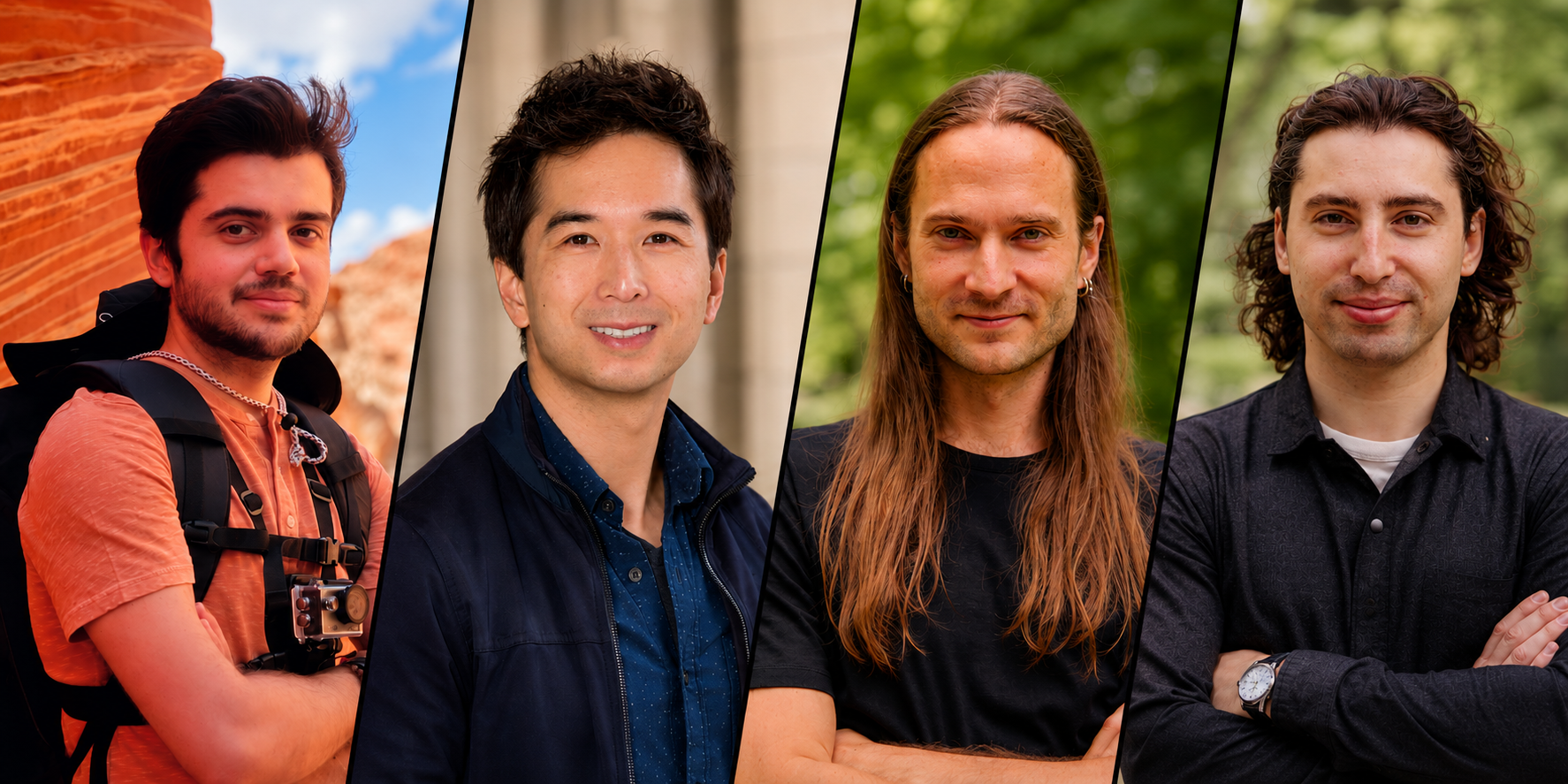
Today, we’re announcing Radical Numerics’ $50 million seed round to build general biological intelligence. We’re also previewing our next-generation genome language model (gLM) called Omnii.
Read more about:
We started Radical Numerics to drive the frontier of biological AI for both design and defense, and ultimately to master the language and code of life. We believe this is the most important scientific and technological challenge of our time. AI that can understand biology and reason across every molecule and modality will help humanity cure disease, engineer new medicines, and defend against biological threats.
This belief comes from something our team helped make possible. Before Radical Numerics, our founding team trained Evo and Evo 2, the largest biological AI models trained on DNA. These models learned from millions of genomes across all of life, from microbes to mammals. We released them fully open source, establishing the field now known as generative genomics and showing that biological sequence models could scale.
Last year, scientists used Evo to generate the world's first complete genome from scratch using AI. It was a bacteriophage, a virus that infects bacteria. In short, a model trained to read genomes had learned to write a working one. For us, it was a clear turning point. It showed us that AI is no longer limited to reading and describing biology. It is beginning to write and generate functional life forms. Eventually it will control biological function and, inevitably, generate new forms of life.
That should make all of us incredibly excited. It should also make us uneasy. (Anyone can design DNA with a new function, and have it synthesized and delivered, like something from Amazon Prime). The same technology that might help us cure cancer is the very technology that might create the next global pandemic, or worse. We believe these forces are inseparable. If you work on the frontier of biology, you have to build technology to safeguard it from its misuse. This means for frontier biological AI, the design lab and the defense lab need to be the same entity.
Introducing Omnii
As our first step toward this dual mandate in human health and biodefense, we are previewing Omnii, our next-generation gLM.
Omnii is built to move beyond the first generation of gLMs. It leverages scale, a new multi-hybrid architecture with a 2M-token context window, and the introduction of multimodality. Omnii is also the first aligned large-scale genome model, incorporating both mid- and post-training methods to transform a genome language model into a reliable scientific instrument.
Across our evaluation suite, Omnii is the first gLM to beat every specialized model family that has divided this space.
For human health, Omnii sets a new frontier for decoding the genome. It far surpasses CADD, Evo 2, and sequence-to-function models across core genetics benchmarks, with especially strong performance in noncoding and regulatory regions where much of human disease biology lives. We are partnering with a diagnostics company to explore Omnii for early cancer detection, and we believe future versions of the model can become a foundation for therapeutic design, variant interpretation, and functional genome engineering.
For biodefense, we are developing Omnii to detect the next generation of biological threats, whether natural, synthetic, or AI-generated. As biological design models improve, the world will need systems that can identify "deepfake" pathogens, detect suspicious sequences, attribute engineered function, and help defenders keep pace with increasingly powerful design tools. Existing detection systems are not enough. We are partnering with a U.S. national lab to pilot Omnii for biosurveillance and pathogen detection.
A new kind of AI lab
We are now building the infrastructure required to scale the most powerful biological AI models in the world. We have a data center under construction, filled with NVIDIA Blackwells. But compute alone is not enough. Building general biological intelligence requires a new kind of AI lab. We need to scale on physical biological data, design new model architectures for long-context and multimodality, build alignment methods for biology, and develop mechanistic interpretability tools that show us what these models are learning.
Radical Numerics brings together AI researchers, systems engineers, computational biologists, and scientists from institutions including Stanford, MIT, and Google DeepMind. But more importantly, we are united by a shared belief: that biological AI will be one of the defining technologies of this century, and that it must be built with both ambition and responsibility from the start.
We started Radical Numerics to master the code of life and to ensure this power is used to save lives. If that's the problem you want to spend the next decade on, we're hiring.