Genome language models can design cancer vaccines
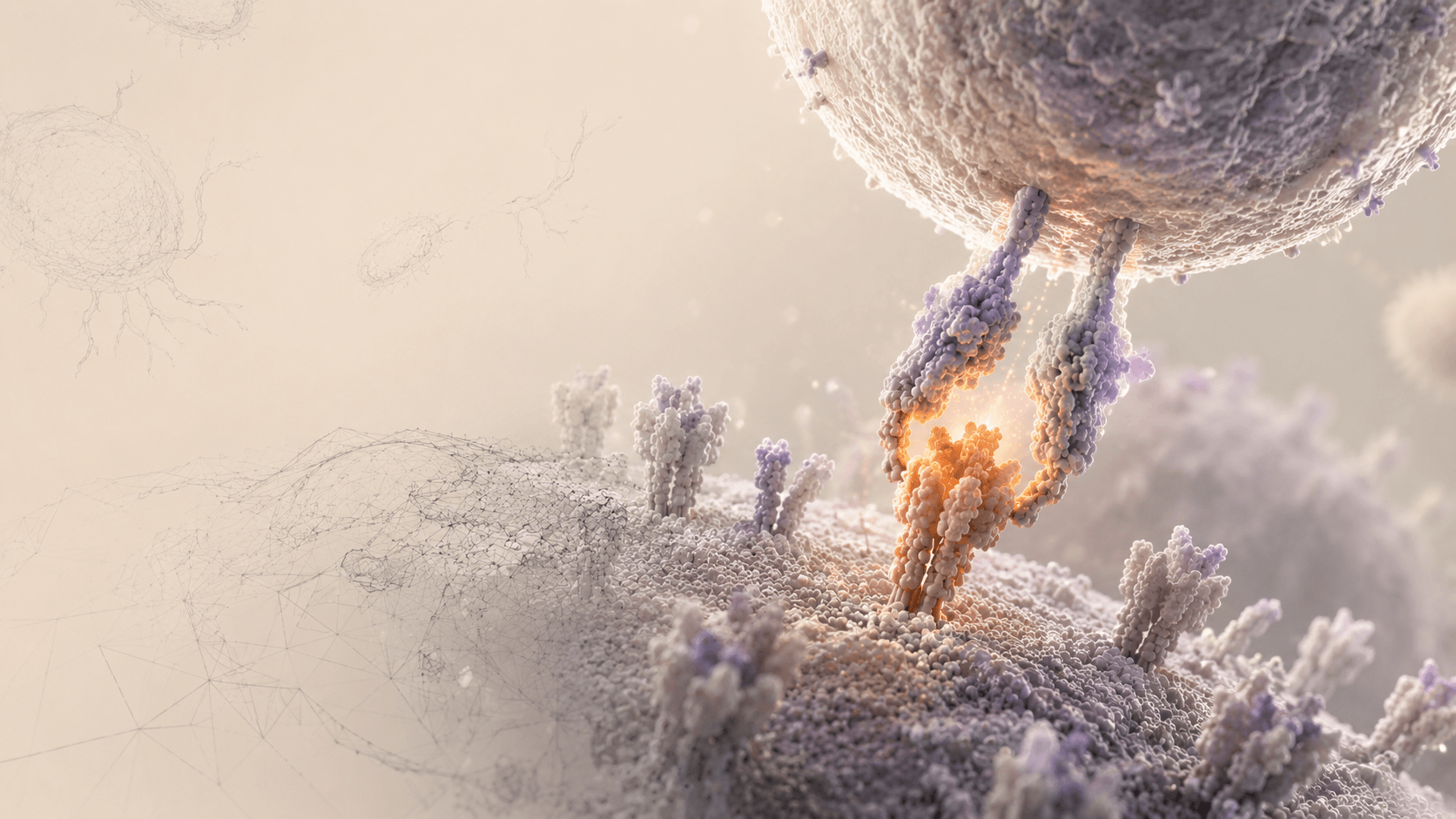
Cancer vaccines are one of the clearest opportunities for AI to contribute to the design of a personalized medicine. We post-trained Omnii, our next-generation genome language model, for end-to-end cancer vaccine design.
For over a hundred years, scientists have dreamed of using our own body's defenses to fight cancer. In principle, our immune system already has what it needs to destroy cancer cells. The problem is knowing what to attack.
Cancer begins as our own cells, making it difficult for the immune system to distinguish what is dangerous from what should be left alone. And even when it does recognize the threat, cancer can change, hide, and blend back into the crowd. To make things even harder, every patient's cancer looks different (one person's pancreatic tumor differs from someone else's pancreatic tumor).
The idea behind a cancer vaccine is deceptively simple: teach the immune system what the cancer looks like, so it can recognize those cells as dangerous and hunt them down.
A cancer vaccine is, in a sense, a set of molecular "wanted posters," showing the immune system exactly what to look for. And yes, the name is a little confusing. We usually think of vaccines as something you get beforehand, to avoid getting sick. But these cancer vaccines are therapeutic, they are designed for patients who already have cancer. Instead of preventing an infection, they train the immune system to attack a disease already growing inside the body.
Recently, Moderna and Merck announced a landmark result: the first personalized cancer vaccine to succeed in a Phase 3 trial1. For patients with melanoma, they sequenced each patient's tumor, identified mutations unique to that cancer, and created a personalized set of molecular "wanted posters" to help the patient's own immune system hunt it down. It is a historic milestone. But it is also just the beginning.
The Moderna/Merck result is in melanoma, a cancer particularly amenable to immune attack2. There are more than a hundred other types of cancer, many far more difficult for the immune system to see and attack. And every tumor brings its own mutations, its own biology, and its own ways of escaping.
So the bigger question is: can we do this again? Can we learn to design a personalized vaccine for any tumor, for any patient?
Doing that is fundamentally a design problem. We have to read the unique biology of a patient and their tumor, reason across many different biological signals, choose what the immune system should be taught to attack, and ultimately turn those decisions into an mRNA sequence that can become the vaccine.
Unlike traditional drug development, the algorithm is not merely helping discover the medicine, it is part of the medicine.
This is what makes cancer vaccines such a natural problem for AI, and particularly for genome language models. Biology is written in sequences, but understanding which sequence to design requires much more than DNA alone. It requires connecting information across DNA, RNA, proteins, gene regulation, and the immune system, and the three-dimensional structures those molecules form when they interact.
We designed Omnii3, our multimodal genome language model, with this in mind, to flexibly read any biological sequence. Omnii is in research preview, but we decided to see if post-training could teach it to design a cancer vaccine. Let's start from the beginning.
Building a cancer vaccine
So how do you actually make one of these "wanted posters"? It starts with a tumor. We sequence it (read its DNA), compare it with the patient's healthy cells, and look for mutations that are unique to the cancer. That gives us a list of possible targets. Often, there are hundreds4, most of them useless. But at the end of the day, each "wanted poster" is a sequence.
A mutation might look interesting on paper but never become visible to the immune system. Another might become visible, but the immune system simply ignores it. Only a small fraction make good targets for a vaccine. The real challenge, then, is figuring out which mutations the immune system will actually see, and which ones it will care about.
Every cell is constantly showing the immune system what's inside
Our cells have a remarkable surveillance system. They continually chop up proteins from inside themselves into tiny fragments, called peptides, and display some of those fragments on their surface using molecules called major histocompatibility complex (MHC) proteins. You can think of MHC as a little display case on the outside of every cell.
T cells patrol the body inspecting these displays. Most of what they see is normal and gets ignored, but if a cell displays something suspicious, and a T cell recognizes it, the immune system can attack.
Cancer gives us an opportunity because mutations can create peptides that healthy cells do not have. Those are exactly the kinds of differences we would like to put on our molecular "wanted posters." The difficulty is predicting which ones will work.
The cancer vaccine design problem
At a high level, designing a personalized cancer vaccine involves six steps:
- Read the tumor. Sequence the patient's cancer and identify mutations that distinguish it from healthy cells.
- Generate possible targets. Turn those mutations into candidate peptide fragments that could serve as "wanted posters."
- Ask: will the tumor actually display it? Predict whether each peptide will be presented on the surface of the patient's cancer cells.
- Ask: will the immune system actually respond to it? Predict whether a T cell will recognize that presented peptide as something worth attacking.
- Choose the best set. From hundreds or thousands of possibilities, select the handful most likely to produce a useful immune response.
- Build the vaccine. Encode those targets into an mRNA sequence that can actually be manufactured and given to the patient.
Steps 3 and 4 are the hardest:
Of all the possible mutations in this patient's cancer, which ones should we teach the immune system to attack?
That comes down to two predictions.
Will the tumor show it?
And, if it does:
Will the immune system care?
These are known as presentation and immunogenicity. They are also where much of the intelligence in a cancer-vaccine algorithm has to live.
How to use Omnii to design a cancer vaccine
This is a surprisingly natural problem for a genome language model. A mutation does not have a fixed meaning by itself. Its effect depends on the sequence around it, the protein it changes, the patient's particular immune system, which MHC molecules they carry, what the tumor is expressing, and how all of those pieces interact. Context matters.
That should sound familiar to anyone who works on language models. The meaning of a word depends on the sentence around it. In biology, the consequence of a mutation similarly depends on the biological "sentence" in which it appears.
But biology has another wrinkle, in that sequence is only one view of the problem. Molecules made from those sequences fold into three-dimensional structures and physically interact with one another. These physical interactions, between peptides, MHCs, and T cells, determine whether or not the immune system responds.
Genome language models are trained to learn those relationships directly from biological sequences. Omnii takes this further by pre-training across DNA, RNA, epigenomics, protein sequences and tokenized protein structure, giving it a shared representation across many of the biological layers involved in this decision.
With focused post-training, we can then ask that general biological model a much more specific question. Is this a good target for this patient's immune system?
Task 1: Will the tumor show it?
Imagine we identify a promising mutation in a tumor. That alone isn't enough. For the immune system to attack it, a fragment containing that mutation first has to make its way to the surface of the cancer cell and fit into one of the patient's MHC molecules. If that never happens, the immune system effectively never sees our target. This first prediction is called presentation.
And presentation is highly personal. Humans carry different versions of MHC genes, so a peptide that is prominently displayed in one patient might never appear at all in another. The question Omnii has to answer is:
Given this peptide and this patient's MHC molecules, how likely is the cancer cell to put it on display?
From an AI perspective, the model's task is to use the peptide and patient's MHC sequences to predict the probability that the peptide will be presented. But pre-training allows Omnii to leverage more than just the raw sequences. Because it has also been trained on protein structure, it has a representation of the physical shapes these sequences can form and how a peptide may or may not sit inside an MHC binding groove.
Task 2: If the tumor shows it, will the immune system care?
Passing the first test still isn't enough. A cancer cell might display a mutated peptide perfectly, and the immune system may simply shrug. A T cell has to recognize that particular peptide as something dangerous enough to attack. This second prediction is called immunogenicity. It is arguably the more difficult question.
Presentation asks whether a peptide will be visible. Immunogenicity asks what happens after it is seen. Will a T cell recognize it? Will it activate? Will it mount a meaningful response against the tumor? For a cancer vaccine, this distinction is the most important aspect. A perfect wanted poster is useless if nobody recognizes the face. So the goal is to find peptides that meet both criteria:
- The tumor displays them.
- The immune system attacks them.
From an AI perspective, this is another prediction problem, but a much noisier one:
Given the peptide, the patient's MHC, and the biological context of the complex being shown to the immune system, predict whether it is likely to trigger a T-cell response.
This is another place where structure is a natural signal. A T cell does not encounter a peptide as a string of amino-acid letters, it encounters the three-dimensional surface formed by the peptide sitting inside an MHC molecule.
In ML terms, presentation asks will this peptide appear? Immunogenicity asks conditional on it appearing, will the immune system respond?
Teaching Omnii to make these predictions
We post-trained Omnii to predict both presentation and immunogenicity for MHC class I and class II (ideally we want to engage both: one helps direct the attack, the other helps organize and sustain it). For every candidate, the model sees the peptide together with the patient's particular MHC sequence and predicts whether it will meet both requirements. We then compared Omnii with widely used specialized models built for the same tasks. For presentation, Omnii performed comparably to or slightly better than representative specialized tools:
- Class I presentation:
Omnii0.939 vs. BigMHC-EL 0.9335 - Class II presentation:
Omnii0.945 vs. NetMHCIIpan-4.3-EL 0.9356
The more interesting result came from the harder question: immunogenicity.
- Class I immunogenicity:
Omnii0.750 vs. BigMHC-IM 0.558 and PRIME2.1 0.5147 - Class II immunogenicity:
Omnii0.778 vs. ImmuScope-IM 0.7538 and TLimmuno2 0.6139
Predicting what appears on a cancer cell is useful. But ultimately, a vaccine succeeds only if the immune system acts on what it sees. That second problem is where Omnii showed its largest advantage.
What's exciting about these results is that a general pretrained model, never trained specifically for cancer vaccine design, appears to have already learned biological features that can be surfaced through post-training to achieve state-of-the-art performance.
These results should also be interpreted carefully. Public immunogenicity datasets10 remain relatively small and heterogeneous. Different experiments measure immune responses differently, and some MHC types have substantially more data than others. We therefore evaluate performance separately across MHC alleles before averaging the results. Most importantly, a benchmark does not represent a patient. Strong predictive performance is encouraging, but the more important test is whether better predictions produce better vaccines and, eventually, better outcomes for patients.
Ranking the best candidates
When designing a cancer vaccine, we don't need Omnii to be right about every peptide, we need it to be very right about the best ones. A tumor might give us hundreds of possible neoantigens, while an actual vaccine may contain only a few dozen. Imagine receiving 500 possible wanted posters but being allowed to hand the immune system only 10. You care much more about whether the best targets are ranked 1, 2, 3, 4 and 5 than you do about which candidate was ranked 437.
That is why we evaluated how precisely the models identify immunogenic peptides when allowed to select only the top 5, 10, or 20 candidates. Omnii's advantage was strongest when the number of available slots was smallest, the regime most similar to actually designing a vaccine.
What could that mean for an actual vaccine?
We can make this more tangible. Suppose a patient's tumor gives us 100 plausible neoantigen candidates, but the vaccine has room for only five. And suppose only around 6% of those candidates are truly immunogenic, a rate consistent with what has been observed in experimental neoantigen studies11. Which five should we choose?
In our simulation:
Omnii: 1.3 of the 5 selected peptides would be expected to be immunogenic- BigMHC-IM: 0.7
- NetMHCpan-4.1-BA: 0.6
- PRIME2.1: 0.6
- Random selection: 0.3
That may sound like a difference of less than one peptide, but that could be the difference between a vaccine that succeeds at teaching the immune system to recognize the tumor, and one that fails. When you only get a handful of shots on goal, choosing the right ones matters enormously.
Putting it all together, from a tumor sequence to an mRNA vaccine
At Radical, we love models, but our primary motivation is impact. So we built an end-to-end pipeline around Omnii to go from patient tumor sequence, to mRNA vaccine. It's state-of-the-art on public data, but this is a setting where post-training data will likely matter for the real world. We invite cancer vaccine researchers to reach out to use Omnii in their own pipeline and to sign up for early access.
It starts with two pieces of information unique to each patient:
- the mutations found in their tumor; and
- their particular set of MHC molecules.
It ends with an optimized mRNA cassette containing the neoantigens selected for their vaccine.
We can also use Omnii for codon optimization of the cassette design itself, which was surprising. That's pretty neat, and deserves a blog on its own at some point.
Overall, what's especially exciting is that a general biological model like Omnii can outperform custom, task-specific models. We see these results and emergent capabilities as merely the beginning.
Cancer vaccines require a whole-system design
Today, we can break cancer-vaccine design into neat boxes: identify mutations, predict presentation, predict immunogenicity, rank targets, design RNA. But biology is not actually divided that way. Whether a target makes a good vaccine candidate may depend on all kinds of information at once:
- Is the mutation really present throughout the tumor?
- Is the gene highly expressed?
- What protein does it alter?
- Will the resulting peptide bind this patient's MHC?
- What does that peptide–MHC complex look like in three dimensions?
- Is the peptide sufficiently different from healthy tissue?
- Will a T cell recognize it?
- Does our set of targets cover multiple populations of cells inside the tumor?
- Can all of those targets be encoded into an mRNA molecule that expresses reliably?
The optimal answer may not be the peptide with the highest score on any one test. It may be the one that performs best across a combination of them, giving the immune system the most robust possible picture of the cancer.
This is why we're building a general biological model rather than a collection of disconnected predictors. Cancer vaccine design is inherently multimodal: DNA tells us what changed, RNA and epigenomics tell us what is active, protein sequence tells us what molecule is produced, structure tells us how those molecules may physically interact, and immune data tells us what the body actually responds to.
Omnii was built to bring those signals into the same model. It is trained across DNA, RNA, proteins, epigenomics, and protein structure, allowing information learned in one representation of biology to inform another.
Learning more about DNA should help us reason about proteins, learning more about proteins should help us reason about immune recognition, and learning whether a vaccine target actually worked should make the next design better. This has to go far beyond natural language only, and learn directly from the underlying raw biological data itself, an area where we're already pushing the boundaries.
Cancer vaccines are therefore an unusually direct test of whether an AI model can take what it has learned about biology and use that knowledge (via post-training) to design a medicine for one particular human being.
Join the next frontier of AI
Personalized cancer vaccines are just getting started. We now know the basic idea can work, but almost every part of the algorithm can still get better: predicting what tumors display, predicting what T cells recognize, incorporating expression and tumor heterogeneity, choosing combinations of targets, and learning directly from experimental and clinical outcomes.
For AI researchers, this is an extraordinary problem. The input is the biological code of an individual patient, the output is a medicine designed specifically for them, and better algorithms mean better medicines.
If you are an AI researcher or research engineer who wants to build on the frontier of grand challenges like this, we're hiring.
If you have unique immunology data, experimental systems, or the ability to validate personalized cancer vaccines, we're excited to collaborate and leverage Omnii to drive the field forward, and ultimately, save lives.
Reach out to us at health@radicalnumerics.ai.
Citation
@misc{omnii_cancer_vaccines_2026,
  title        = {Genome language models can design cancer vaccines},
  author       = {Fields, Alexander and Poli, Michael and Nguyen, Eric},
  year         = {2026},
  month        = {Sep},
  url          = {https://www.radicalnumerics.ai/blog/omnii-cancer-vaccines},
  organization = {Radical Numerics}
}
References
1.Merck and Moderna. "Phase 3 INTerpath-001 trial of intismeran autogene plus KEYTRUDA met endpoints of recurrence-free survival and distant metastasis-free survival in patients with completely resected stage IIB–IV melanoma." Press release (19 August 2026).
2.Schumacher, T.N., Schreiber, R.D. "Neoantigens in cancer immunotherapy." Science 348(6230), 69–74 (2015).
3.Radical Numerics. "A new frontier in generative genomics with Omnii." (2026).
4.Vogelstein, B., Papadopoulos, N., Velculescu, V.E., Zhou, S., Diaz, L.A., Kinzler, K.W. "Cancer genome landscapes." Science 339(6127), 1546–1558 (2013).
5.Albert, B.A., Yang, Y., Shao, X.M., et al. "Deep neural networks predict class I major histocompatibility complex epitope presentation and transfer learn neoepitope immunogenicity." Nature Machine Intelligence 5(8), 861–872 (2023).
6.Nilsson, J.B., Kaabinejadian, S., Yari, H., et al. "Accurate prediction of HLA class II antigen presentation across all loci using tailored data acquisition and refined machine learning." Science Advances 9(47), eadj6367 (2023).
7.Gfeller, D., Schmidt, J., Croce, G., et al. "Improved predictions of antigen presentation and TCR recognition with MixMHCpred2.2 and PRIME2.0 reveal potent SARS-CoV-2 CD8+ T-cell epitopes." Cell Systems 14(1), 72–83.e5 (2023). Benchmarks use PRIME2.1, the current release.
8.Shen, L.-C., Zhang, Y., Wang, Z., et al. "Self-iterative multiple-instance learning enables the prediction of CD4+ T cell immunogenic epitopes." Nature Machine Intelligence 7(8), 1250–1265 (2025).
9.Wang, G., Wu, T., Ning, W., et al. "TLimmuno2: predicting MHC class II antigen immunogenicity through transfer learning." Briefings in Bioinformatics 24(3), bbad116 (2023).
10.Vita, R., Blazeska, N., Marrama, D., et al. "The Immune Epitope Database (IEDB): 2024 update." Nucleic Acids Research 53(D1), D436–D443 (2025).
11.Wells, D.K., van Buuren, M.M., Dang, K.K., et al. "Key parameters of tumor epitope immunogenicity revealed through a consortium approach improve neoantigen prediction." Cell 183(3), 818–834.e13 (2020).

